Tuesday, July 13, 2010

How to Get Nice Rice

OIC conducts workshops to train women on how to add more value to what they produce. Monday was the first day of 3 day OIC's rice processing intervention in Dawunipe and Bagpe, two communities in Central Gonja.

The local rice that these women currently process sells for less than the rice processed in other communities, like Navrongo in the Upper East. This OIC intervention aims to teach these women how to process their rice better so that they can sell it at a higher price. That's why OIC hired 2 women from Navrongo to teach these women their methods.

The way the local women currently process their rice is to boil and dry the grains in the hot sun, resulting in less than ideal rice. I learned that to get good rice, one has to thoroughly wash the grains, steam them, and then dry them gradually in a shady place.


On Wednesday, after the rice went through the mill, we delivered the finished product to the communities. If you look closely, you can see the huge difference between the previously processed rice and the rice processed with the new and improved method.


Oh, and a woman offered me a spot in her house as her husband's second wife. Thanks!..but no thanks. Proposals of marriage are so common here that you learn to think nothing of it.

I made friends with the village kids, rather they made friends with my camera. They got so excited and cheered whenever I showed them the picture of themselves on the screen.


Next time you're in a village where you can't speak the language, just pull out your camera and you've got yourself instant friends.

Thursday, July 8, 2010

SO. MANY. SHEEP.

Apologies for the long gap between posts. No, I didn't sink into a depression after Ghana was eliminated from the World Cup after being soooooooo close, though it was pretty sad those first couple of days. I lost access to the Internet for a bit, but thankfully it's back. For now, at least.

Last Wednesday I went out to the field with the organization OIC Ghana. OIC stands for Opportunities Industrialization Centers, and it was founded by an African-American minister in Philadelphia to train people for various vocations. The OIC program based in Tamale focuses on the 4 components of agriculture, water and sanitation, maternal and child health nutrition, and microenterprise development.

Part of the microenterprise facet includes the distribution of sheep and goats. OIC Ghana is solely funded by USAID (United States Agency for International Development), and uses the money to buy the animals. As you can see in the picture, there were SO. MANY. SHEEP.

This picture doesn't even capture the constant bleating of the approximate 200 sheep kept in the pen. It took a good hour for the men to rope up and load the very unwilling sheep onto the trucks to deliver to the lucky women of the Langantire community in West Gonja, about a hour and a half drive from Tamale. The sheep arrived before we did, waiting impatiently in groups of 5. Before simply handing over the sheep just like that, proper documentation had to be done. The women had to provide their thumbprint as a signature. Their husbands also had to be present to stand as witnesses.


Numbered sheets of paper were given out to the community kids, and they stood by each group of sheep.


To ensure fairness, the process of giving out sheep was based on a ballot system. That way no woman had any unfair advantages over one another.


I watched the women walk home with their new assets, happy for them, yet not really understanding how rearing sheep is considered an income-generating activity. Aren't they only useful for their wool and meat? It was only later that I found out just how lucrative sheep could be. From May through August, there is no harvest, meaning no food. The task of finding food for the family is transferred from the man, who farms, to the woman. I thought you could just kill one of your sheep for its meat, but what would you eat it with? In communities such as these, meat isn't consumed often and is more of a luxury. Instead it's much more profitable to spare them and use the money to buy maize flour, and even pay hospital bills and school fees. Better yet, when the sheep produces offspring, you give the kids to another family so that they can raise their own sheep. This is known as "passing on the gift," which not only repeats the cycle, but also fosters unity in the community.


Wow. Who knew sheep could be so useful? Hats off to you, sheep of the world.

Sunday, June 27, 2010

Ghana v. USA: A Tale of Two Homelands

1 vuvuzela: 10 Ghana Cedis
1 Ghana flag: 12 Ghana Cedis
Watching Ghana knock the USA out of the World Cup and advance to the quarterfinals: PRICELESS

I can’t even begin to describe what happened last night. It’s a new feeling for me, being so incredibly proud of one’s country simply because of a sport.

It was bittersweet, though. I’m a proud American (I stood up for the national anthem) and felt bad that the U.S. lost, especially after they exceeded the world’s expectations by reaching the Round of 16.

But!

I’m also a proud Ghanaian and my elation over Ghana’s victory far outweighed my sadness for the USA’s loss. And because I felt that a win for Ghana would mean so much more for this small nation than the USA, which is dominant in practically everything, I was rooting for the Black Stars.

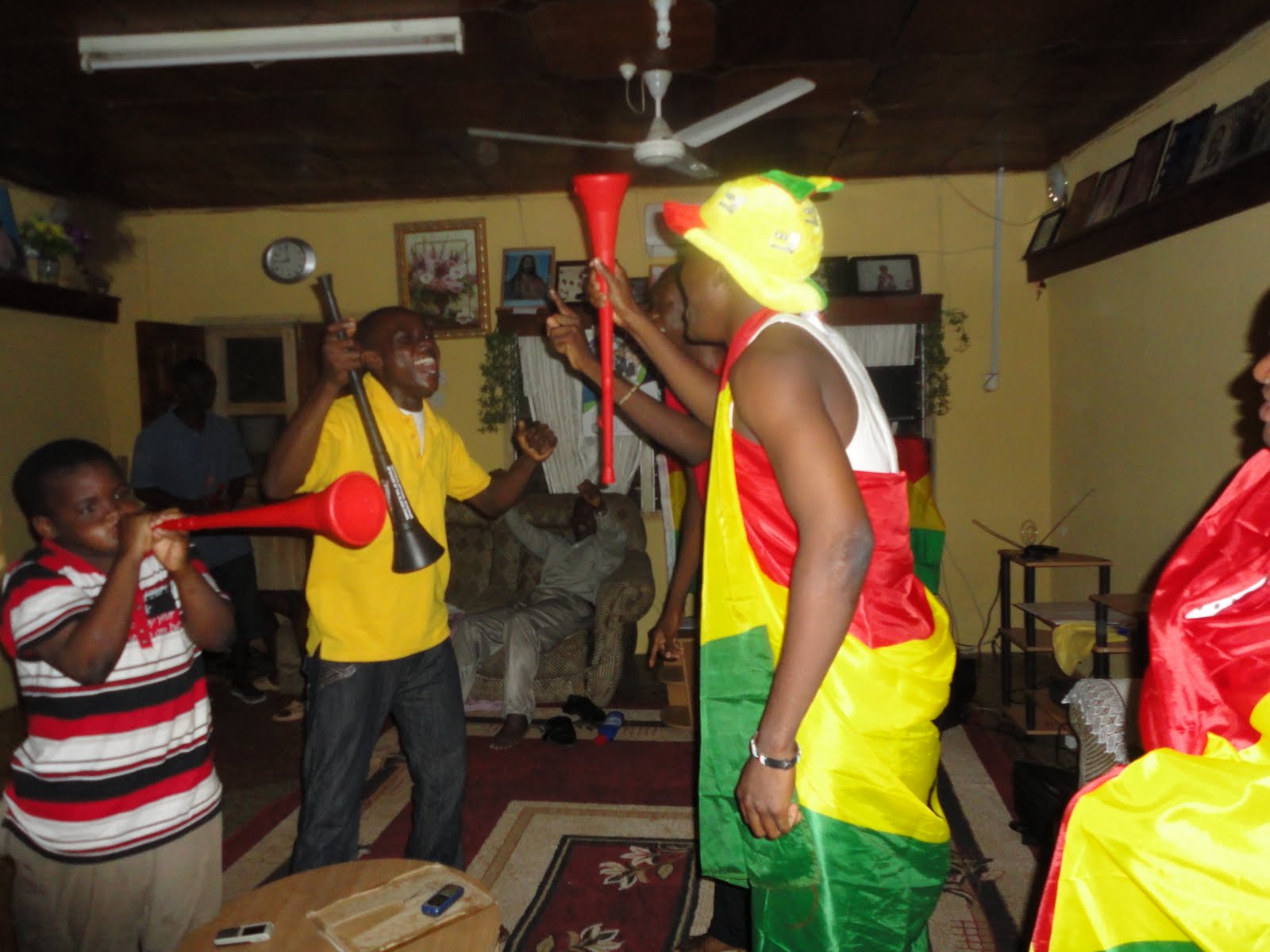
The atmosphere in the hours leading up to the match was tense. I watched in confusion as my cousin lay moping around, hardly talking and refusing to eat. I learned that it was a sort of “pre-match meditation.” I admit, I was nervous for Ghana and doubtful of their performance in the World Cup so far, especially since the 2 goals they’d scored so far were from penalties. Still, I was ready to cheer on Ghana with my flag and vuvuzela at hand. It wasn’t long—5 minutes to be exact—before the room we all gathered to watch the match in exploded with the sound of cheers and vuvuzelas.

I was pretty relaxed and only hoped that Ghana could hold on to their lead, up until the U.S. scored in the 2nd half. I’ve never been so stressed watching a soccer match before. Those 30 minutes of extra time seemed so long. But I cheered and romped with everyone else when we scored our second goal, which ultimately won us the match and allowed us to knock the U.S. out of the tournament for the second time in a row.

Almost immediately after, about ten of us crammed into the Land Cruiser--flags, vuvuzelas, and all--and my uncle drove us into town to celebrate.

Now,“celebrate” is a vague term. I expected to go to a bar or something for some victory drinks and call it a night. Little naïve me from the suburbs was not prepared for all that took place on the city streets of Tamale under the full moon last night.

“Riot” is the only word that comes close enough to what I witnessed. Only it wasn’t violent.
Crowds of people were dancing to the beats of loud drums I couldn’t see, motorbikes were weaving in and out of traffic doing wheelies, and the red, yellow, green, and black colors of the Ghanaian flag seemed to be everywhere. I’m still trying to get used to the wild driving here already, what with the scarcity of traffic lights and overtaking being the norm, but to be honest, I was a LITTLE scared that we would get into an accident. I asked my uncle if these people were drunk. He replied, “Drunk with joy!” If this is what people are like after watching their country win a match, I’d like to see them after a couple of drinks…

Regardless of whether or not Ghana advances any further (though I hope they do!) nothing could replace Saturday night. I’m proud of Ghana.

Unfortunately my camera battery died (it couldn't handle all the excitement) before we reached the really wild part of town, but this is what I managed to capture.


Wednesday, June 23, 2010

Bolga: Days 3 + 4

Let me take a moment to congratulate the Black Stars on qualifying for Round of 16! Although we lost the match against Germany, we're still in! And of course, all of Ghana is celebrating. With all this soccer, I do miss watching Wimbledon (the Isner v. Mahut match is the longest match ever, with 100+ games, and it's not even finished yet!)

Okay, enough of sports.

All of yesterday and today, data collectors conducted the baseline surveys in various communities in the Talensi-Nabdam and Kassena-Nankana Districts. Each district speaks different languages, so data collectors had to be able to speak the language of those in the communities in order to accurately complete the questionnaires.


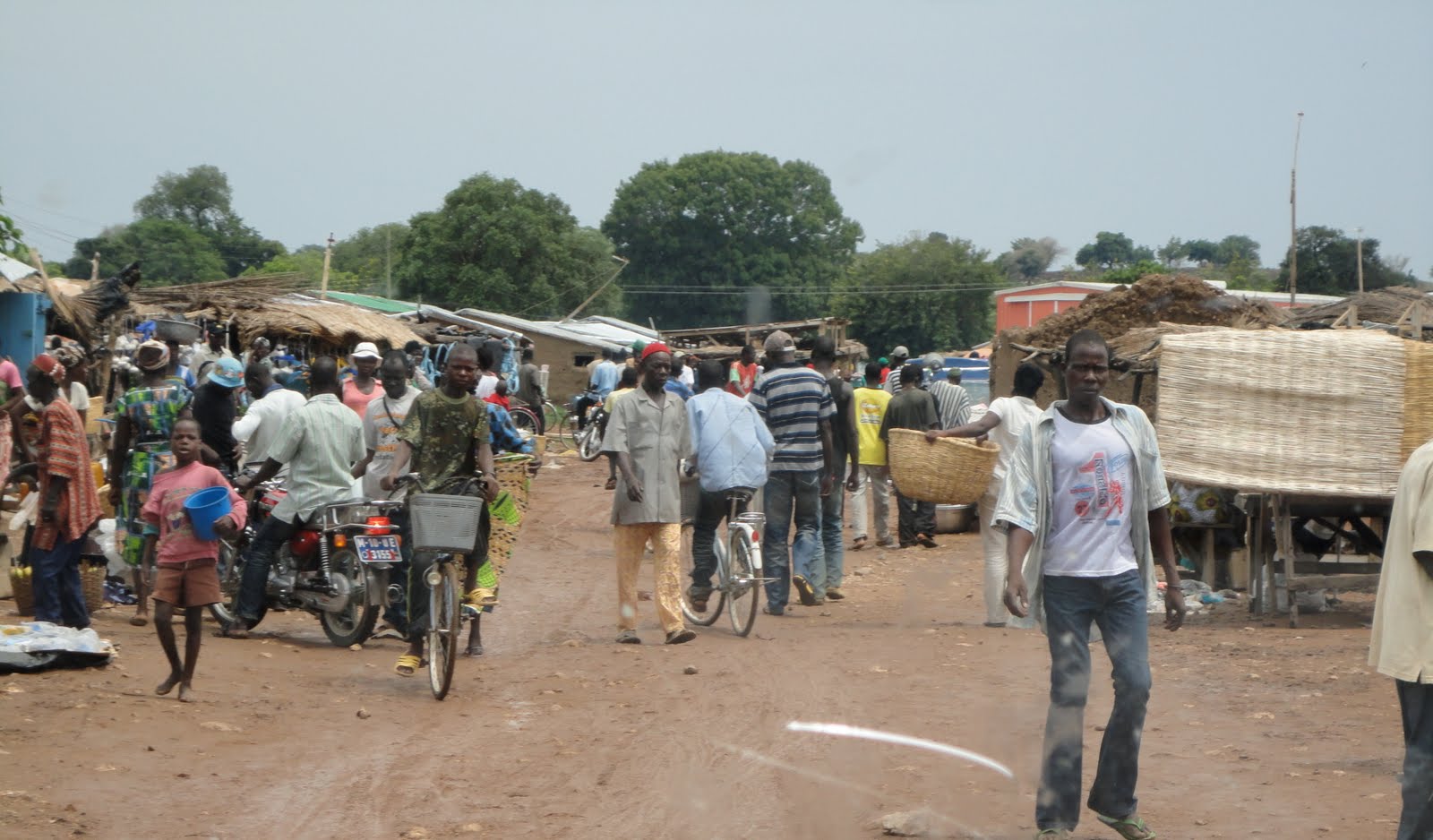
Yesterday was also market day in the area, so I saw lots of men, women, and children alike on the roadside with empty baskets on their heads, walking, driving carts pulled by donkeys, or riding bikes and motorbikes.


I tried the shea fruit for the first time today in the Kotintabig community. I was a little skeptical because honestly, they smelled horrible. Since everyone was saying that it was sweet and kept urging me on, I relented. How could I turn down sweetness? I was disappointed. It didn't taste as sweet as I expected, tasting kind of salty instead. But I can't hate it when the seeds are used to make the shea butter that my hair so dearly loves.


Needless to say, I still prefer mangoes by a loooooooongshot.

The community had given guinea fowl eggs to the data collectors, who then generously gave them to me. They're supposed to taste much better than chicken eggs. Can't wait to eat them!

I'm heading back to Tamale tomorrow. Though these past few days in Bolga were busy and tiring, it was worth going out into the communities and seeing exactly what organizations like CRS are doing on the ground and seeing such projects in action. I only hope I get more opportunities like these in the future.

Monday, June 21, 2010

Bolga: Day 2

Today I got my first taste of what field work entails. And lemme tell you--it's not easy driving down bumpy roads, going from community to community. I commend everyone who does this, day in, day out. By the end of the day, weak little me was so tired, so hot, and so hungry...

I, along with 2 CRS project officers and the driver, traveled out to Navrongo, which is a town just outside of Bolga. People who have donated the funds that have helped make possible the projects CRS-Ghana is undertaking are visiting from the U.S. on Friday. We went to three of the communities to make sure everything was ready and in place for the visit.

I've never realized just how much I take running water for granted. Clean water at that. We put our dishes in the dishwasher, indulge in long, hot showers, and drink from the tap without a second thought. But here, the water situation couldn't be more different. Even in cities like Accra, water isn't guaranteed to flow out the faucet when you turn it on. And in rural areas, where I visited today, people, mostly women and children, walk miles to a water source that, in many cases, isn't clean, infecting people with diseases such as Guinea worm. (Please don't Google Image this. I beg!)

The first community we visited featured a water pump built by the donations of CRS based in Seattle. Since the water comes from deep down in the ground, it's clean and safe to drink, even cleaner and safer than tap water. I was able to drink some and it did taste good. Here it is in action.


Up until now, I've underestimated the power of witnessing things firsthand. While watching this boy collect water and bring it back home to his family, it really hit me that such a simple mechanism can save the lives of so many. And it makes you wish that every community that needed this had one. But it's so much easier said than done.

After that, we went to the Nokang community. This is the CIMACS scoreboard that tracks the progress the community has made:

The picture on the left shows a woman delivering a baby at a clinic, and the right shows a woman delivering at home. Currently, this community has a 90% success rate, meaning that most women deliver at a clinic. This is no small feat. That the clinic is often miles away from the community and that most deliveries happen at night makes going even more difficult than it already is. As I mentioned in my last post, CIMACS provides motorbikes, raincoats, and rain boots to link providers so that they can quickly get a woman in labor to the clinic.

With the help of CIMACS and its volunteers, this woman


was able to deliver this healthy (and cute!) baby.


I wanted to end this slightly gloomy post on a happy note. With the image of a calm, sleeping newborn in my head, I'm off to bed! I've discovered that so many people say "Yoooooo!" as a farewell. And all this time, I thought it was just something weird my mom said before she said bye on the phone, but it's quite widespread here. So now, I shall say it too.

Yooooo!

Sunday, June 20, 2010

Bolga: Day 1

I'm writing from my hotel room in Bolgatanga, with the Brazil v. Cote d'Ivoire match on in the background. It's become a sort of routine for me here, watching soc--I mean, football every day. More on the always interesting World Cup--and the antics it inspires in its loyal aficionados--later. Anyway, I'm here in Bolga, which is in the Upper East Region, to observe firsthand the work Catholic Relief Services (CRS) does in rural communities. I visited the CRS office in Tamale last week where I was able to learn about 2 projects the organization is undertaking in developing rural communities in Ghana: CIMACS and SILC. (CRS really loves its acronyms...)

CIMACS, which stands for Community Initiative on Maternal, Child, and Newborn Survival is a 3-year program begun in 2009 to reduce maternal and child mortality in the Upper East Region of Ghana, where communities are especially susceptible to high mortality rates. CRS works with Ghana Health Services which nominates high-risk communities. A needs assessment is conducted to ascertain the things the communities lack, like roads, water, better farming tools, and money for starting businesses. CRS gathers at least half of the community and takes a vote; if the community decides as a whole that its most pressing need is health, the community is chosen.

I'll highlight just a couple of aspects that I found particularly interesting about CIMACS. CRS employs the "Positive Deviant" strategy, which identifies the few people in the community whose behaviors are seen as deviant by other members, but in reality are positive. In this case, it would be delivering a baby at a clinic instead of in the home--the traditional method. This also includes the concept of breastfeeding. Many locals think that breast milk is bad, and give newborns cow's milk instead, but breast milk is the ideal choice because it provides essential nutrients that help strengthen a baby's immune system, which is crucial. CIMACS promotes "immediate and exclusive breastfeeding" for up to 6 months. Also, traditional birth attendants (TBAs) are given items as incentives for them to give up their job of delivering babies in the home, and become link providers, essentially "linking" expectant mothers to the clinics. CRS gives TBAs items such as motorbikes, raincoats, and rain boots to make it easier for them to transport expectant mothers to the clinic, where it is both cleaner and safer, and ensures a healthy delivery.

The other project is SILC, Savings and Internal Lending Communities, which provides a way for members of the community to pool their money together in a safe place. SILC integrates with CIMACS by financing the items given to the link providers. A group consists of ~25 members that meets weekly. The money is collected and kept in a box that has 3 padlocks. One person keeps the box, and 3 people keep the keys for the 3 different padlocks. These four people are scattered throughout the community. I think this is a pretty cool way to protect against theft and instill a sort of connectedness among the group. Money is set aside for special things, like social and savings funds. There are fines for lateness to the group meetings, which is put in the box. After 10-12 months of saving, the group "graduates" and the money is shared among the group in proportion to their contribution over the months. Some achievements of this program include providing loans to members who want to start up a small-scale business (ex: selling roasted groundnuts), and even encouraging co-existence among different ethnic groups.

Today consisted of training the data collectors, which number around nine. They're mostly graduate students and those who have experience with researching in the field. Their main task is to translate the CIMACS-SILC baseline survey into the local languages. The questionnaire asks basic questions such as marital status, education level, and becomes even more specific, asking respondents to rank their mode of transportation (donkey, bicycle, motorcycle, etc), how much money they have saved, and about maternal care. This serves as a way to gauge how the community as a whole goes about delivering babies.

Filling out a questionnaire seems straightforward enough, I thought, but the translation of the questions from English to the local language is critical. Each survey will be done orally, given to about 40 members of the community, so extra care must be taken. For example, one question asks "How many people live in your household?" Seems easy enough, right? But the choices are: 1) 5 or less, 2) between 6 and 10, 3) between 11 and 15, 4) between 16 and 20, 5) more than 20. The concept of extended family is important in the culture of Ghana and many African countries, but the question means the nuclear family, or how one person put it, "those who eat from the same pot."

I hope I'll have a lot more to report as I go through the week, but for now...

GOOOOOOOOOOOOOAL!

I can't stress enough how great it is to be in Ghana during the World Cup. Yesterday, we all gathered to watch the Ghana v. Australia match, specially projected on the wall.


Waiting in anticipation as Asamoah Gyan prepares for his penalty kick and....


GOOOOOOOOOOOOOAL! (Please note the annoying vuvuzela, the bugle-like instrument that has been the constant backdrop of all the matches, which sounds even worse in real life).

The song sung after every goal:


And the amazing (????) dancing that takes place. This is from the Ghana v. Serbia match.


This was long. Props to you for making it this far!

Monday, June 14, 2010

12 hour travels + World Cup Fever

I left Accra on Saturday with my aunt and a driver. We left at 7am and arrived around 6:30pm. That’s TWELVE HOURS by car. Here’s the visual:
In between naps, I managed to take some shots of the road.


Hawkers stand by the road and bombard your car if you make so much as eye contact. But it’s a convenient way to get your shopping done without ever getting out of your car. By the end of the trip, the backseat was packed with loaves of bread, fruit, etc.


Cattle roaming freely by the roadside. Back in the States, you’d probably get arrested and charged for animal abandonment or abuse or something.


A billboard in Kumasi. Inspired by a certain presidential campaign, I wonder...Plus the drinking age is 18. Take note, America.

Look at the size of those mangoes! We stopped to buy some of course. I've been eating them all week. Life is good.

This is me with my cousins Victor and Annette, all dressed for church on Sunday. Mass was long and hot, but at least it was lively, with all the upbeat songs and dancing.

After church, we all gathered around to watch Ghana v. Serbia soccer match. We won 1-0, but it was more entertaining to watch the guys celebrate. I hear the whole of Ghana was heartily celebrating their first win. It's refreshing be in a country so infected with the fever of the World Cup. And to think, if Ghana went on to win the whole thing...